
Many people want to get stronger but worry about joint pain, injuries, or hard workouts. If you feel the same, low impact strength training can be a smart choice. It combines low impact resistance training, low impact strength exercises, and low intensity resistance training to help you build strength without putting too much stress on your body.
In this guide, you’ll learn everything you need to know about low impact strength training, including its benefits, the best exercises, and simple tips to get started. Whether you’re a beginner, older adult, or recovering from an injury, this article will help you find a safe and effective way to improve your strength.
Summary
- Low-impact strength training builds real muscle and functional strength while reducing stress on knees, hips, shoulders, and the lower back.
- It relies on controlled tempo, full range of motion, and steady time under tension rather than jumping or explosive impact.
- It suits beginners, busy professionals, postnatal women, older adults, and even seasoned athletes who need better recovery between hard sessions.
- Twelve exercises, ranging from bodyweight squats to reformer-style resistance work, cover every major muscle group without a single jump.
- Consistency, progressive overload, and recovery habits matter more than raw intensity for long-term results.
- Studio-based formats like Lagree pair guided resistance and tempo coaching with these same principles, making progress easier to track and sustain.
What is Low Impact Strength Training?
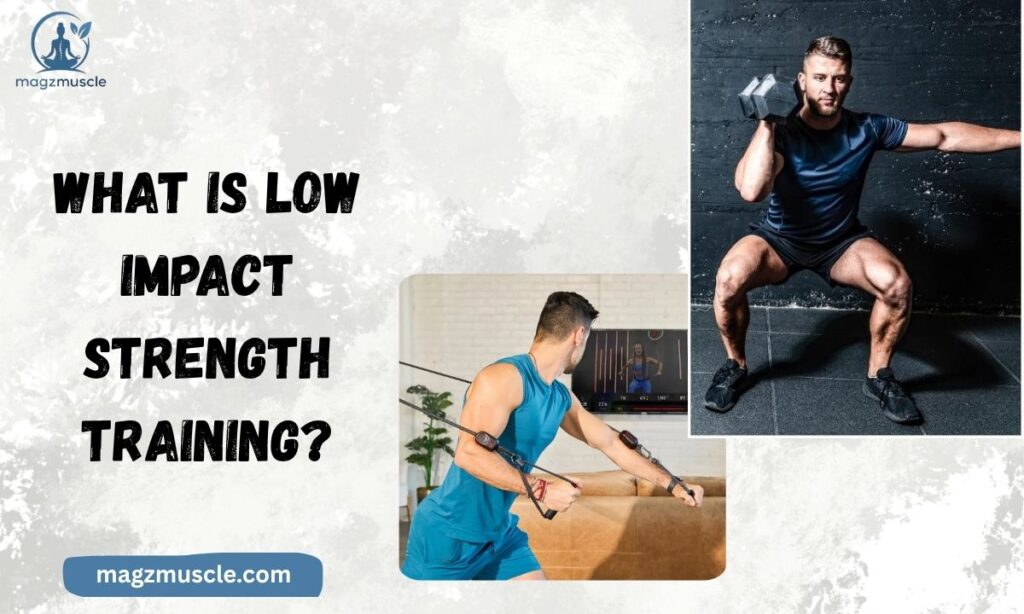
Low-impact strength training is a style of resistance exercise that builds muscle while keeping at least one foot grounded and avoiding jumping or hard landings. It relies on controlled tempo, resistance bands, bodyweight, or machines to keep tension on the muscle throughout the movement.
It is not the same as “easy” training, since intensity comes from control and time under tension rather than speed. You can still fatigue your muscles and raise your heart rate without a single jarring impact.
| Feature | Low-Impact Strength Training | High-Impact Training |
| Ground contact | At least one foot grounded at all times | Feet leave the ground (jumping, running) |
| Primary driver of intensity | Tempo, resistance, time under tension | Speed, force, momentum |
| Joint stress | Low | Higher |
| Best suited for | Beginners, joint issues, busy schedules, recovery days | Healthy joints, athletic conditioning, calorie burn |
| Equipment | Bodyweight, bands, reformer, light machines | Bodyweight, plyo boxes, running, jump rope |
Why Does This Approach Actually Suit Busy Women?
It packs strength, core work, and light cardio into one efficient session, so a single 30 to 45 minute workout can cover what would otherwise take two or three separate sessions.
Because the movements are controlled rather than explosive, recovery time is shorter too. That means a woman juggling work, family, and a training schedule can show up two or three times a week and still see steady progress, instead of needing extra rest days to recover from pounding, high-impact classes.
How Does It Spare Joints While Staying Intense?
The intensity comes from slower tempo, longer time under tension, and deliberate resistance rather than speed or force. Muscles absorb the load instead of joints taking a repeated jolt with every rep.
Keeping at least one foot on the ground, moving through a controlled range, and avoiding sudden deceleration all reduce the shear forces that typically irritate knees, hips, and lower backs. Your muscles do the heavy lifting, quite literally, while your joints simply move through a safe, supported range.
What Breaks With The Familiar Ways People Exercise?
Most people default to running, jumping classes, or heavy barbell lifts because that is what “real training” has always looked like. It works, until repeated impact catches up with cartilage, tendons, and old injuries.
Low-impact strength training breaks that pattern. It proves you do not need to pound pavement or crash through burpees to build noticeable strength, tone, and stamina. Once people feel how challenging a slow, controlled squat or a held plank actually is, the old assumption that low impact means low effort tends to disappear fast.
What Should You Check For When Choosing A Low-Impact Strength Session?
Look for a class or plan that includes progressive resistance, a clear tempo, and instructor or program guidance on form. A good session should challenge your muscles to fatigue within a set number of reps or a set time, not just keep you moving.
Also check that it covers upper body, lower body, and core in a balanced way, and that there is a clear plan for increasing difficulty over time, whether through added resistance, longer holds, or slower tempo.
Related Reading
- Best Toning Exercises for Women
- Reformer Pilates Body Transformation
- Benefits of the Pilates Reformer
- Reformer vs Mat Pilates
- Lagree vs Weight Lifting
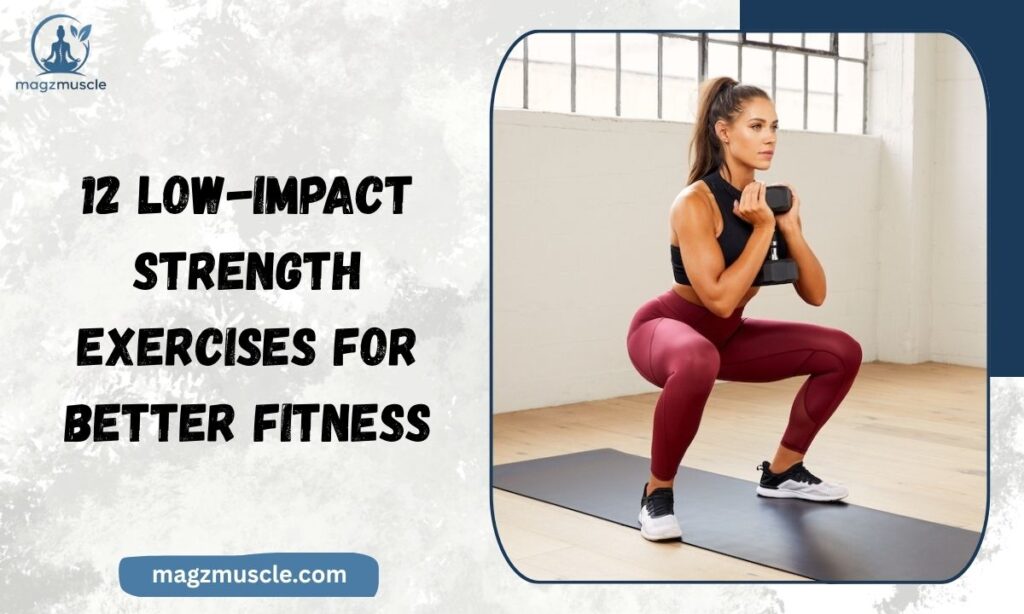
12 Best Low-Impact Strength Training Exercises to Try
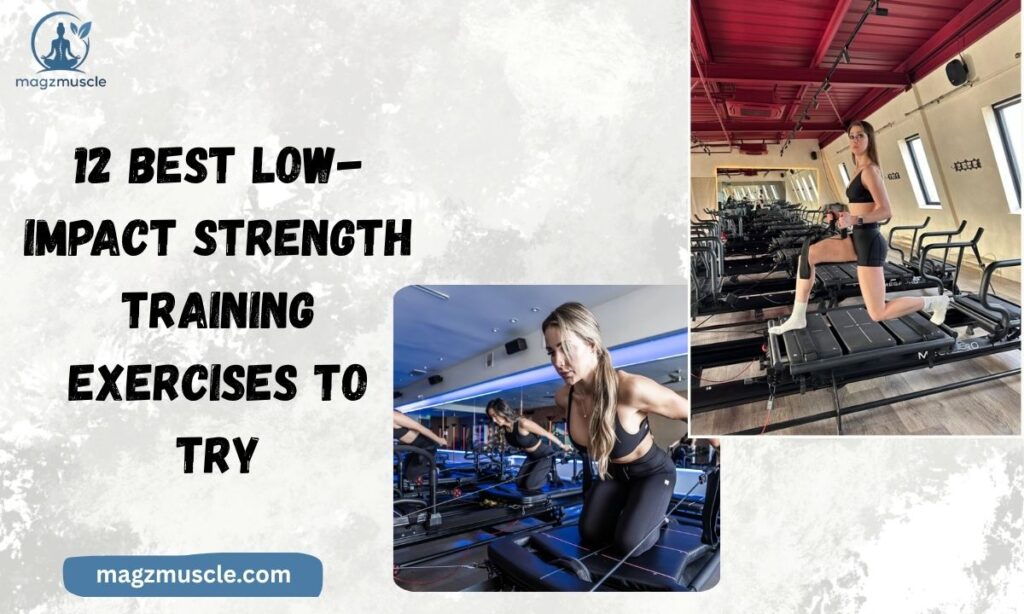
Each of the following exercises builds strength while keeping stress on your joints to a minimum. Together, they cover your legs, glutes, core, back, chest, and shoulders, so you can build a complete, balanced routine without a single jump or hard landing.
1. Lagree Training
Lagree training uses a reformer-style machine with adjustable spring resistance to create constant tension throughout every movement. It targets the full body at once, combining strength, core stability, and light cardio in a single low-impact session.Sessions typically run 8 to 15 slow, controlled reps per exercise, or holds of 30 to 60 seconds, with resistance increasing as you get stronger.
Because the carriage moves smoothly and there is no jumping involved, it is one of the most joint-friendly ways to reach genuine muscle fatigue. Many studios, including those offering Lagree in London, structure entire classes around this format for exactly that reason.
2. Bodyweight Squats
Bodyweight squats build strength in your quads, glutes, and hamstrings while improving hip and ankle mobility.
Lower for a slow 3-second count, pause briefly at the bottom, then rise with control. Aim for 10 to 20 reps. Keep your chest up and push your knees out in line with your toes to protect your joints throughout the movement.
3. Reverse Lunges
Reverse lunges strengthen each leg individually, which helps correct muscle imbalances and improves pelvic stability with far less stress on the knee than a forward lunge.
Step backward slowly, lower until your front thigh is close to parallel with the floor, then drive back to standing. Perform 8 to 12 reps per side, keeping your weight centred over your front heel.
4. Glute Bridges
Glute bridges activate the entire posterior chain, including your glutes, hamstrings, and lower back, without compressing the spine the way squats or deadlifts can.
Lie on your back with knees bent, feet flat on the floor. Lift your hips until your body forms a straight line from shoulders to knees, hold for 2 seconds, then lower slowly. Do 12 to 20 reps, squeezing your glutes at the top of every rep.
5. Dead Bugs
Dead bugs train deep core stability and teach your spine to stay neutral while your limbs move, which protects your lower back in almost every other exercise you do.
Lie on your back, arms extended toward the ceiling, knees bent at 90 degrees. Slowly lower one arm and the opposite leg toward the floor, keeping your lower back pressed down, then return and switch sides. Perform 8 to 12 reps per side.
6. Resistance Band Rows
Resistance band rows strengthen your upper back and shoulders, which counteracts the forward, hunched posture that comes from sitting at a desk all day.
Anchor a band at chest height, step back to create tension, and pull the band toward your ribs while squeezing your shoulder blades together. Do 10 to 20 reps with a controlled tempo, pausing briefly at the point of maximum contraction.
7. Step-Ups
Step-ups build unilateral leg strength and improve balance, and they closely mimic the movement pattern of climbing stairs, which makes them highly functional for daily life.
Step onto a sturdy bench or box, driving through your front heel to stand fully upright, then step back down with control. Perform 8 to 12 reps per leg, choosing a step height that keeps your knee tracking safely over your foot.
8. Wall Sits
Wall sits build isometric quad endurance without any joint movement at all, making them one of the gentlest yet most demanding exercises on this list.
Slide your back down a wall until your knees form roughly a 90-degree angle, then hold. Start with 20 to 30 seconds and build toward 60 to 90 seconds as your endurance improves. Keep your knees aligned over your ankles throughout the hold.
9. Hip Hinges
Hip hinges teach your body to move safely through your hips rather than your lower back, which is the foundation for lifting almost anything, from a kettlebell to a laundry basket, without injury.
Stand with feet hip-width apart, then push your hips backward while keeping a soft bend in your knees and a long, neutral spine. Lower until you feel a stretch in your hamstrings, then drive your hips forward to stand. Perform 10 to 15 reps.
10. Static Lunges
Static lunges isolate single-leg strength and balance in a stable stance, which reduces the joint impulse that comes with stepping lunges.
Set your feet in a long split stance, then lower your back knee toward the floor with a slow 3-second descent before pressing back up. Do 8 to 12 reps per side without moving your feet between reps.
11. Modified Push-Ups
Modified push-ups build pressing strength through your chest, shoulders, and triceps while reducing the load compared to a full push-up on the floor.
Place your hands on a bench, box, or wall, keep a straight line from shoulders to knees or feet, and lower your chest with control before pressing back up. Perform 6 to 15 reps depending on your current strength, progressing to the floor as you get stronger.
12. Pilates Mat Work
Pilates mat work develops deep core control, coordination, and joint-friendly mobility through slow, breath-driven movement.
Exercises like the hundred, single-leg circles, and controlled roll-ups use small, precise ranges of motion rather than heavy load. Use mat work as a warm-up, a cool-down, or a standalone session focused on precision rather than reps.
The Hidden Cost of “Cardio-Style” Strength: Why Your Gains Are Stalling and Joints Ache
Treating strength training like cardio, rushing through reps to keep your heart rate up, feels productive in the moment. Over time, it quietly wears down your knees and shoulders while your actual strength gains barely move.
Slowing down and controlling every rep fixes both problems at once. It keeps your joints safe and forces your muscles to do the work your heart rate alone cannot measure.
The Power of 45 Minutes: Why Focused Resistance Training Outperforms Longer, Less Targeted Workouts
A focused 45-minute session, built around controlled resistance and full-body coverage, often produces better results than 90 minutes of unstructured gym time. Fatigue sets in with purpose rather than through random exercise selection, so every minute of the session contributes to progress.
That is the model behind boutique low-impact strength studios and Lagree-based classes across London, where a single well-structured session replaces the need for separate cardio and strength days.
Low Impact Strength Training for Weight Loss
Low-impact strength training supports weight loss by building lean muscle, which raises your resting metabolic rate, and by keeping workouts consistent because your body recovers faster between sessions. Muscle tissue burns more calories at rest than fat tissue, so adding strength work, even without a single jump, shifts your body composition over weeks and months.
Circuit-style low-impact sessions, where you move between resistance exercises with minimal rest, also elevate your heart rate enough to burn calories during the workout itself. Combine that with a sensible eating pattern and two to four sessions a week, and low-impact training becomes a genuinely effective weight loss tool, not just a gentle alternative to “real” cardio.
The biggest advantage for weight loss specifically is sustainability. High-impact plans often get abandoned after a joint flare-up or an injury. Low-impact strength training keeps you training week after week, and consistency is what actually drives fat loss over time.
Low Impact Strength Training at Home
You do not need a gym membership or expensive equipment to do this well. A few resistance bands, a mat, and your own bodyweight cover almost everything on this list.
A simple at-home structure looks like this:
- Warm up for 5 minutes with marching in place, hip circles, and arm swings.
- Choose 5 to 6 exercises from the list below, covering lower body, upper body, and core.
- Perform 2 to 3 rounds of 8 to 15 reps per exercise, resting 30 to 60 seconds between moves.
- Finish with 5 minutes of stretching, focusing on hips, hamstrings, and shoulders.
Aim for two to four sessions a week, alternating muscle groups if you train more frequently. Because these movements are joint-friendly, you can train more often than you could with high-impact workouts, which speeds up progress without adding wear and tear.
Low impact strength training for beginners
If you are new to strength training, start with bodyweight versions of the exercises above: squats, glute bridges, modified push-ups, and static lunges. These moves teach proper movement patterns before you add external resistance.
A simple beginner plan:
- Train 2 times a week to start, building to 3 as your body adapts.
- Choose 5 exercises covering lower body, upper body, and core.
- Perform 1 to 2 rounds of 8 to 12 reps, resting as needed between sets.
- Focus entirely on form and controlled tempo rather than speed or rep count.
Expect the first two to four weeks to feel like a learning curve. Strength gains come quickly once your body learns the movement patterns, usually within 6 to 8 weeks of consistent training.
Low impact strength training for seniors
For older adults, low-impact strength training helps maintain bone density, balance, and independence in everyday movement, all with a much lower risk of injury than high-impact exercise.
Safe starting points include:
- Wall sits, held for shorter durations initially.
- Seated or supported glute bridges.
- Step-ups using a low, stable step.
- Resistance band rows performed seated or standing with support nearby.
- Hip hinges practiced without weight first, focusing purely on the movement pattern.
Two sessions a week, with an emphasis on balance and controlled movement, is a reasonable starting point. Always check with a doctor before beginning a new program, particularly if there is an existing joint condition, recent surgery, or cardiovascular concern.
Benefits of Low-Impact Strength Training Exercises
Low-impact strength training builds real, lasting strength without the recurring pain or burnout that often comes with harder training styles. It protects your joints while still challenging your muscles enough to see genuine change.
The benefits go beyond the workout itself, carrying over into daily life, better posture, easier movement, and steadier energy throughout the week.
- Faster recovery, with fewer flare-ups and less joint strain over time
- Better consistency, since joint-friendly sessions are easier to sustain long term
- Improved metabolism and composition, as lean muscle raises resting calorie burn
How Does It Speed Recovery And Reduce Flare-Ups?
Controlled, low-impact resistance work improves circulation around joints and helps rebuild deconditioned muscle without provoking new inflammation. Clients recovering from injury often notice fewer pain spikes within a few weeks of consistent training.
Why Do Women Actually Stick With It?
People stay consistent with routines that fit their schedule and do not leave them sore or injured for days afterward. Shorter, joint-friendly sessions remove the all-or-nothing barrier that causes most fitness plans to fail.
Can Low-Impact Work Still Change Your Metabolism And Composition?
Yes. Sustained muscular tension and progressive resistance build lean muscle, which raises your resting metabolism and supports fat loss even without high-impact cardio.
What Happens To Confidence, Posture, And Everyday Movement?
Regained strength improves posture and reduces the small compensations people make when carrying bags or children. Many clients report standing taller and moving with more confidence within weeks.
The Inconsistency Trap: Why Alternating Cardio and Ad-Hoc Strength Training Fails When Life Gets Busy
Bouncing between random cardio days and occasional strength sessions feels manageable at first, but it fragments progress once life gets busy. Structured, low-impact resistance sessions consolidate strength, cardio, and mobility into one repeatable format, which protects gains even during hectic weeks.
How Does This Approach Change The Emotional Relationship With Exercise?
Workouts stop feeling like a punishment once they stop causing pain. That relief is often what keeps people coming back, turning exercise into a source of momentum rather than dread.
Related Reading
- Body Sculpting for Women
- Is Reformer Pilates a Good Workout
- How Many Calories Does Reformer Pilates Burn
- How Often Should You Do Reformer Pilates
- Barre vs Lagree
Who Should Do Low-Impact Strength Training Exercises?
Low-impact strength training works for almost anyone, from complete beginners to seasoned athletes managing a heavy training load. It builds real strength while keeping the risk of injury and joint irritation low.
The common thread is a need for sustainable progress, whether that means easing into fitness safely or protecting joints that already carry years of wear.
- Beginners and returners, who need manageable, confidence-building sessions
- People with joint pain, arthritis, or past injuries, who need reduced repetitive stress
- Busy or high-volume exercisers, who need better recovery between hard sessions
Who Should Start Here If You Are New Or Nervous?
Anyone intimidated by high-intensity classes benefits from the smaller, more manageable challenge of low-impact strength work, since early wins build confidence before heavier resistance is introduced.
Who Benefits If You Already Train Hard?
Runners, HIIT enthusiasts, and other high-volume exercisers use low-impact strength sessions to boost muscular endurance and speed recovery between harder workouts.
Who Should Pick Low Impact For Health Reasons?
People with chronic joint pain, past surgeries, or arthritis benefit most, since this style of training reduces repetitive stress on already sensitive joints.
When Should You Be Cautious Or Seek Guidance?
Anyone with uncontrolled cardiovascular conditions, acute inflammation, or a recent surgery should get medical clearance and start with supervised, low-intensity sessions before progressing further.
What Most People Do Now, And Why It Fails
Most people patch together long cardio sessions and sporadic strength classes because it fits their schedule. Over time, that inconsistency fragments recovery and stalls progress.
How Does This Change Your Relationship With Exercise
Structured, joint-friendly training builds a base of solid mechanics, which makes every other type of exercise feel safer and more effective as intensity increases.
From Quick Results to Lasting Change: How Women Maintain Lagree Gains Beyond the Studio
Studio-based low-impact training, such as Lagree in London, gives clients a structured framework they can carry into home workouts and everyday movement, helping results last well beyond the class itself. Pairing regular sessions with the at-home routine outlined earlier in this guide keeps progress moving between studio visits.
Getting the Most from Low-Impact Strength Training Exercises

Low-impact strength training only pays off when you approach it with intention, not just movement for movement’s sake. Small, deliberate choices around tempo, resistance, and recovery are what separate steady progress from a plateau.
The goal isn’t to work harder each session, but to work smarter within it. Consistency, tracked progress, and recovery habits matter just as much as the exercises themselves.
To get the most out of every session, focus on:
- Progressing gradually by changing one variable at a time, such as tempo, resistance, or range of motion
- Tracking objective markers like hold times and rep symmetry instead of relying on the scale alone
- Prioritising recovery through sleep, mobility work, and proper nutrition to keep intensity sustainable
How Should I Plan Progression to Actually Produce Change?
Work in four-week blocks and change one variable at a time, such as tempo, resistance, or range of motion, then track how your body responds before adding another change.
What Do You Do When Joints Flare As Intensity Rises?
Shorten the range of motion, slow your tempo further, and add more contact points with the floor or equipment. If pain persists, swap dynamic reps for matched-duration isometric holds for a week or two.
Which Recovery Habits Actually Move The Needle?
Prioritise 7 to 8 hours of sleep, add a short mobility circuit twice a week, and eat a protein-rich meal within 90 minutes of training to reduce soreness and speed repair.
How Should I Measure Progress So It Feels Objective And Motivating?
Track hold times, rep symmetry between sides, and simple field tests like a timed wall sit or step-up count, rather than relying on the scale alone.
Why Do Many Superior Plans Still Fail For Busy Women?
Even well-designed plans fail without structure and accountability. Scattered training choices dilute progression, which is why standardized formats with clear tempo cues tend to outperform improvised routines.
What Common Mistake Trips People Up At Intermediate Levels?
Trading control for speed. Moving faster to “feel” harder causes form to break down and stalls progress; staying deliberate with tempo produces better long-term results.
What Immediate Tweaks Produce The Biggest Payoff This Week?
Slow down your eccentric phase on one lift, add a short mobility finisher after your next two sessions, and track one objective measure, like a held plank or wall sit time, to see real progress.
Book a Lagree Class in London Today

If you want a structured, joint-friendly way to build strength without the guesswork of piecing together your own program, a Lagree-based session in London brings all twelve of these principles into one guided, 45-minute class.
Certified instructors correct your form in real time, adjust resistance to your level, and keep every session progressing safely.Book a class today and see how controlled, low-impact strength training can build real, lasting results without the wear and tear on your joints.
Related Reading
- Does Reformer Pilates Help You Lose Weight
- Best Toning Exercises for Women
- Benefits of Lagree
- Beginner Pilates Reformer Exercises
Frequently Asked Questions
Is low impact strength training effective?
Yes, low impact strength training builds muscle, improves strength, and protects joints with consistent practice.
What is the 3-3-3 rule gym?
The 3-3-3 rule usually means three exercises, three sets, and three training days weekly.
Can you build muscle with low impact workouts?
Yes, low impact workouts build muscle when combined with progressive resistance and proper nutrition.
Can you recommend a 30-minute low-impact workout for beginners?
Try walking, bodyweight squats, resistance bands, wall push-ups, and stretching for 30 minutes.
What are some examples of low-impact exercises for seniors?
Walking, chair squats, resistance band exercises, step-ups, swimming, and gentle yoga are excellent choices.
What burns 500 calories in 30 minutes?
Running, fast cycling, or intense rowing may burn 500 calories, depending on body weight.
Conclusion
Low impact strength training is a simple and safe way to build strength without putting too much stress on your joints. It works well for beginners, older adults, and anyone returning to exercise. By doing low impact strength exercises regularly, you can improve muscle strength, balance, and daily movement. Low impact resistance training also helps you stay active while lowering the risk of injury. With patience and consistency, low impact strength training can give you long-lasting results.
The best part about low impact strength training is that almost anyone can do it. You can start at your own pace and slowly improve over time. Low intensity resistance training makes workouts easier while still helping you get stronger. Keep practicing low impact strength training, stay consistent, and enjoy better health, stronger muscles, and more confidence every day.